
Losing most or all of your teeth can affect far more than your appearance. Everyday activities like eating, speaking, and smiling comfortably often become more difficult, and many patients notice a decline in confidence and quality of life.
For patients exploring tooth replacement options in NYC, one of the most common questions is whether full arch dental implants offer advantages over traditional dentures. While both treatments restore missing teeth, they function very differently and provide distinct long-term benefits.
At New York Oral & Facial Surgery, we help patients understand the differences between these solutions so they can make an informed decision based on their lifestyle, health, and long-term goals.
What Are Full Arch Dental Implants?
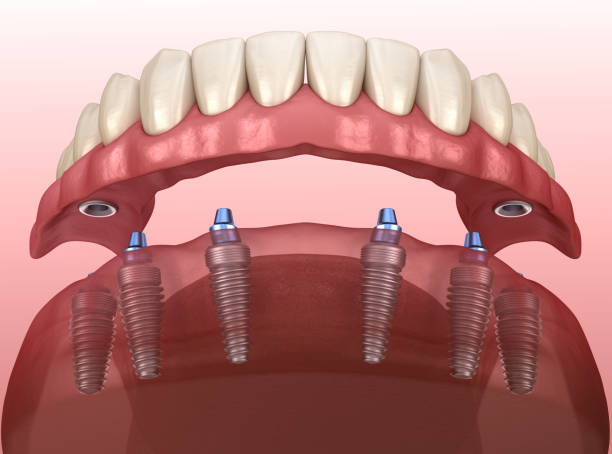
Full arch dental implants are a permanent tooth replacement solution designed for patients missing most or all teeth in the upper or lower jaw.
During treatment, several dental implants are surgically placed into the jawbone. These implants function like artificial tooth roots, creating a stable foundation for a full set of custom replacement teeth.
Unlike removable dentures, implant-supported teeth remain securely fixed in place. Patients do not remove them at night or rely on adhesives to keep them stable.
Because the implants integrate directly with the jawbone, full arch restorations feel more natural and provide significantly greater stability when eating and speaking.
What Are Dentures?
Dentures are removable prosthetic teeth designed to rest on the gums. They are custom-made to fit the mouth and may be held in place with suction or denture adhesive.
Traditional dentures can improve appearance and restore basic chewing ability, particularly for softer foods. They are also typically less expensive initially than implant-supported options.
However, dentures do not replace tooth roots or stimulate the jawbone. Over time, bone loss following tooth loss can cause dentures to loosen, shift, or require periodic adjustments and replacement.
Some patients adapt well to dentures, while others find the movement and maintenance inconvenient.
Full Arch Dental Implants vs. Dentures
The most significant differences between implants and dentures become apparent in daily life.
| Feature | Full Arch Dental Implants | Dentures |
|---|---|---|
| Stability | Fixed securely in place | Removable and may shift |
| Comfort | Feels stable and natural | May create pressure or sore spots |
| Chewing Ability | Strong biting and chewing function | Reduced chewing efficiency |
| Speech | Stable during speaking | May occasionally move |
| Jawbone Support | Helps preserve bone structure | Does not prevent bone loss |
| Maintenance | Brushed like natural teeth | Removed and cleaned daily |
| Longevity | Long-term solution | Often requires adjustments or replacement |
Stability and Confidence
One of the most common frustrations with dentures is movement during eating or speaking. Even minor shifting can make patients feel self-conscious in social or professional situations.
Full arch dental implants are anchored directly to the jawbone, providing a level of stability that traditional dentures cannot match. Patients are typically able to speak, laugh, and eat with greater confidence and fewer concerns about movement.
Eating and Chewing Function
Dentures can make it difficult to comfortably eat certain foods, particularly hard, crunchy, or sticky items.
Because implant-supported teeth are secured to the jawbone, they provide significantly improved chewing strength and control. Many patients are able to return to a more varied diet and enjoy foods that were previously difficult to eat with removable dentures.
Improved chewing ability is often one of the most meaningful quality-of-life improvements patients experience after treatment.
Protecting the Jawbone
After tooth loss, the jawbone naturally begins to shrink due to lack of stimulation from tooth roots.
Traditional dentures sit on top of the gums and do not stop this process. Over time, continued bone loss can affect facial appearance and denture fit.
Dental implants help stimulate the jawbone in a way similar to natural tooth roots, which can help preserve bone volume and support long-term facial structure.
Convenience and Daily Maintenance
Dentures require regular removal for cleaning and overnight soaking. Some patients also rely on adhesives to improve stability throughout the day.
With full arch dental implants, patients care for their restoration much like natural teeth through regular brushing and oral hygiene visits. There is no need for adhesives or nightly removal.
For many patients, this added convenience simplifies daily life considerably.
Long-Term Value
Dentures generally involve a lower upfront cost. However, they often require adjustments, relining, or replacement over time as the jawbone changes shape.
While full arch dental implants typically require a larger initial investment, they are designed as a long-term solution with greater durability and stability.
When evaluating treatment options, it is important to consider not only immediate cost, but also long-term function, comfort, and maintenance.
Who Is a Candidate for Full Arch Dental Implants?
Many patients missing most or all of their teeth may qualify for full arch dental implants, including long-time denture wearers.
A comprehensive evaluation allows the oral surgeon to assess:
-
Overall oral health
-
Bone volume and density
-
Medical history
-
Treatment goals
In some cases, additional procedures such as bone grafting may be recommended to support implant placement.
Why Patients Choose New York Oral & Facial Surgery
At New York Oral & Facial Surgery, treatment planning is guided by advanced imaging, precise surgical techniques, and personalized care.
Our team focuses on creating stable, natural-looking results while prioritizing patient comfort and long-term success. Sedation options are also available to help patients feel relaxed throughout the procedure.
Final Thoughts
Both dentures and full arch dental implants can restore missing teeth and improve quality of life. However, for many patients, implant-supported restorations provide greater stability, stronger chewing function, improved comfort, and better long-term support for oral health.
The best treatment depends on your individual goals, anatomy, and lifestyle. A comprehensive evaluation with an experienced oral and maxillofacial surgeon can help determine which option is most appropriate for your needs.
FAQ
How long do full arch dental implants last?
With proper care and regular dental visits, dental implants can last for decades. Many patients maintain their implants successfully for a lifetime.
Is the procedure painful?
Treatment is performed using local anesthesia, and sedation options are available for additional comfort. Most patients report manageable soreness during recovery.
Can I switch from dentures to full arch dental implants?
Yes. Many patients who currently wear dentures transition successfully to implant-supported teeth. An evaluation will determine whether additional procedures, such as bone grafting, are necessary.
How long does treatment take?
Treatment timelines vary depending on healing and individual needs. In many cases, the full process takes several months from implant placement to final restoration.